Every time you open a browser and type a site address, you are using a domain. But what a domain really is on the internet, how it is structured, and why no serious project can do without one — here is a straight answer without fluff.
A domain is not “the server address”. It is a name
Technically a site lives on a server with an IP address — a number like 195.13.237.73. The browser reaches the resource through that address. Remembering four number blocks for every site is impossible, so we use domain names: human-readable aliases that DNS maps to the right IP.
Roughly, a domain is a label on top of the technical reality. You type mysite.com, the browser asks DNS for the IP of mysite.com, gets an answer, and opens the right server — in milliseconds.
Domains and hosting are different things. Hosting is where the files live. The domain is how people find those files. Think of hosting as the plot of land and the domain as the postal address on it. You can move hosting and keep the same name.
How a domain name is structured
Read a domain right-to-left — from the general to the specific. Take blog.example.com and split it.
The rightmost part (.com) is the top-level domain (TLD): geographic (.ua, .de, .pl) or generic (.com, .org, .edu). In practice nobody checks if you are “commercial” for .com, but .gov and .edu are strictly reserved. Cloudflare explains why DNS hierarchy matters for the resilience of the whole internet — TLD layers let the system scale without a single point of failure.
The middle label (example) is the second-level domain — your unique identifier that you choose and register.
The left label (blog) is a subdomain (third level). The owner creates it without a separate registration — handy for shops (shop.example.com), blogs, dashboards, or language versions.
Why your business needs its own domain
I have seen the same pattern: teams that skipped a proper name and stayed on free constructor subdomains lost traffic when they migrated. A domain is a stable address. Hosting, design, and CMS change — the name stays.
Beyond stability you get corporate email ([email protected]) that builds trust, a modest SEO signal when the name contains a relevant keyword, and a brandable string that is easier to say out loud. Tilda has a practical guide on choosing a domain and what to watch for (Russian UI, but the checklist is universal).
To go deeper on how search engines evaluate a site, read what SEO is — solid metadata matters as much as picking the right domain.
How to pick a domain name that actually works
In my experience a strong name is short (ideally under ~15 characters), easy to pronounce, aligned with the topic, and — crucially — available.
Rules: 2–63 characters, Latin letters, digits, hyphen (not at the start or end). Case does not matter. Cyrillic IDN zones exist but may display as xn-- in some tools — use them carefully.
Avoid homophones: if “F” and “PH” sound the same, half of your audience will mistype. If the base name is taken, ivl123.com can work as a compromise, but it is not ideal.
How to register a domain: step by step
Registration is straightforward; the hard part is choosing the name.
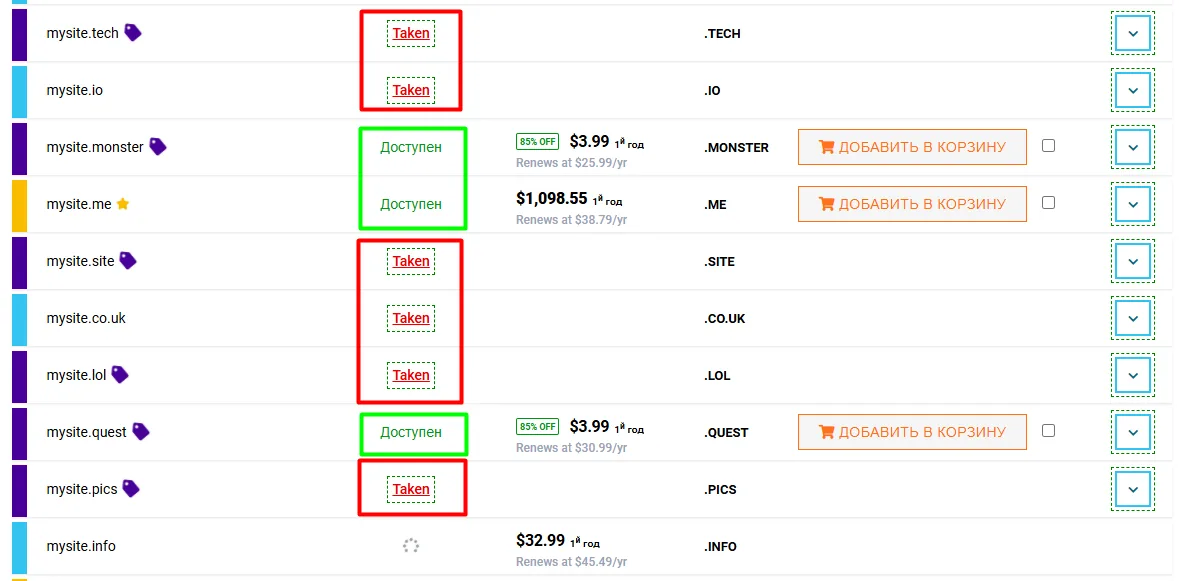
- Check availability via a registrar or Whois — status, dates, sometimes history. If taken, try another TLD (.net, .org, .com.ua) or tweak the label.
- Pick an ICANN-accredited registrar or your country's registry partner. Compare renewal price, not only the first-year promo.
- Choose 1–10 years in most zones. Turn on auto-renew so a missed invoice does not cost you the brand.
- Provide accurate contacts (ICANN requirement). Typos complicate disputes. Use WHOIS privacy if you need to hide personal data in public listings.
- Pay and wait for confirmation. DNS updates may take minutes or up to 24–72 hours.
Leasing and renewals: what to know
You cannot buy a domain forever — it is a lease. Usually one year, up to ten in many zones. After expiry the name is released.
ccTLDs like .ru / .su / .рф can drop quickly after the grace period. Many gTLDs offer a short redemption window at a higher fee.
Enable auto-renew and calendar a reminder 30 days before expiry. Losing a domain that built links and traffic hurts. For how links affect rankings, see our link building article.
How to connect a domain to a site
After registration, point the domain to hosting or a site builder via DNS: either set the host's nameservers or add an A record to the server IP in the registrar panel.
Changes propagate gradually (DNS propagation) — often within 24 hours, sometimes 72. Tools like whatismydns.net help you verify. After go-live, enforce HTTPS; browsers flag plain HTTP as unsafe, which hurts trust and SEO.
For how metadata and technical setup affect visibility, read what meta tags are and how to fill them in properly.
Comparing domain zone types
| Zone type | Examples | Best for |
|---|---|---|
| Generic (gTLD) | .com, .net, .org, .info | Businesses and projects without a strict country tie |
| Country-code (ccTLD) | .ua, .de, .pl, .us | Local businesses anchored to one country |
| Sponsored / thematic (sTLD) | .shop, .blog, .agency | Niche brands that want a topical signal in the name |
FAQ
What is a domain in simple terms?
It is your site's address on the internet — what people type to find you. Technically it is an alias for the server's numeric IP.
Can you buy a domain forever?
No. Domains are leased for at least one year and up to ten in most zones. You must renew or the name becomes available to others.
How is a domain different from hosting?
The domain is the address; hosting stores the files. Without hosting there is nowhere to point the name; without a name users cannot find you easily.
How do I check if a domain is free?
Use Whois or any registrar search. You will see free vs taken, and if taken, expiry/owner data where publicly available.
What happens if I do not renew on time?
The site stops, the domain enters hold/redemption states, then drops. gTLDs may offer a short paid recovery window; ccTLDs like .ua or .ru can move faster.
What is a subdomain and do I need one?
An extra label before the main domain (blog.example.com), created by the owner without a new registration — for sections, languages, or separate apps.
Does the domain name affect SEO?
Moderately. A keyword in the domain is a small signal; stability, history, and content matter more. Dig into how Google ranks sites for the full picture.
Bottom line
A domain is foundational online infrastructure, not an optional extra. Choosing a name, registering with a reliable registrar, enabling auto-renew, and wiring DNS to hosting is a few hours of work that pays off for years.
If you are starting in web development, our web development from scratch guide covers the basics — understanding domains is one of the first building blocks.
ELI5-style threads on Reddit sometimes help the mental model click.

You may also like

Need a site or technical support?
We help with domains, hosting, builds, and growth — clear timelines, minimal jargon.