Every year thousands of people decide to break into IT — and one of the first questions is: which track? Frontend or backend? At first glance both look similar: a computer, code, salaries in dollars. But the gap is real: what you build, the tools you use, and the mindset you need day to day are genuinely different.
This article is not another five-row “pros and cons” table. I will explain the difference between frontend and backend through what the work actually feels like: the tasks you solve, where friction shows up, and how to sense which side fits you. If you are just mapping the territory — read on.
What frontend is: everything you can see
Frontend is the client side of a web application. In plain terms: everything you see in the browser and interact with — buttons, menus, animations, forms, product cards. You click “Buy” — frontend handled the click. The page scrolls smoothly — that is frontend too.
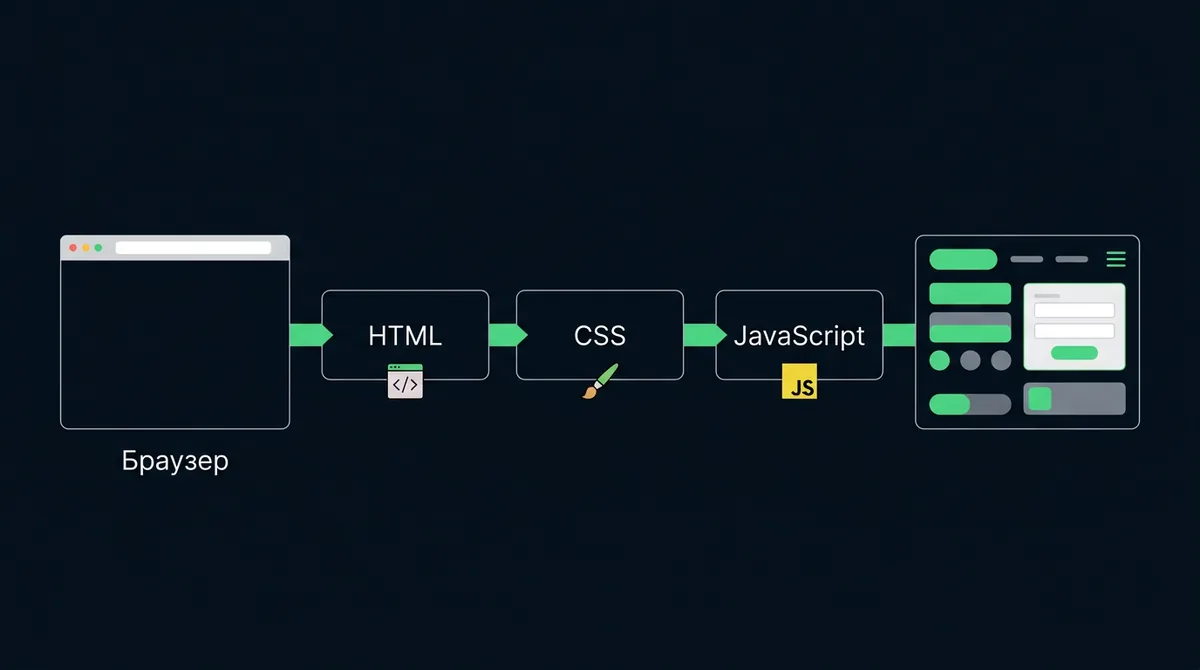
A frontend developer turns a designer’s mock (usually from Figma) into a living interface. The classic trio is HTML for structure, CSS for presentation, and JavaScript for interactivity. Together they form the client layer — code that runs directly in the user’s browser.
In practice modern frontend rarely stays on “vanilla” JavaScript alone. Teams reach for frameworks — React, Vue, or Angular. React from Meta is the most common pick for SPAs and complex UIs with dynamic updates: dashboards, learning platforms, booking flows. Vue is a strong fit when you want a faster ramp and smaller scope — landing pages, blogs, admin panels. Angular is the batteries-included enterprise choice when structure and guardrails matter for CRM-scale systems.
One more reality: frontend is also a performance job. An LCP above ~2.5s (Largest Contentful Paint) is a Core Web Vitals warning — and search engines factor that into ranking. That is why bundle optimisation, lazy-loading media, and solid tooling with Webpack or Vite are not “nice extras”; they are part of the daily craft.
Backend: the logic you do not see — but nothing works without it
Backend is everything that happens after you press a button. The server receives a request, validates data against the database, runs business rules, and sends a response back. For you it may be a second of waiting; for a backend engineer it is a chain that must be fast, reliable, and leak-free.
Practically, backend boils down to three pillars. First, the server — where application logic lives and requests are handled. Second, the database — user profiles, transactions, everything persistent. PostgreSQL and MySQL are classic relational choices for structured data; MongoDB or Redis often appear for other patterns, including caching. Third, the API — the contract through which frontend talks to the server. REST and GraphQL are the two dominant styles, each with trade-offs.
Common backend languages include Python (readable, flexible, strong in startups and ML-adjacent work), Java (strict, scalable, common in banks and large enterprises), Node.js (JavaScript on the server — one language across tiers), and PHP (the long-time CMS and e-commerce workhorse).
Security is a dedicated backend responsibility: input validation, SQL injection defence, solid auth with JWT or OAuth, encryption for sensitive data. A weak backend cannot be saved by a pretty UI.
Frontend vs backend: a comparison without fluff
Many articles stop at a tiny comparison table. But the difference between a backend developer and a frontend developer is not only a technology list — it is a different way of thinking.
Frontend engineers think in user terms: how does this look? Is the next click obvious? Does it adapt on mobile? Does the layout shift while assets load? That sits at the intersection of design and code and rewards detail sensitivity that is hard to automate away.
Backend engineers think in system terms: how should we store this data? Which table shapes stay fast at a million rows? How do we shape APIs so the client receives only what it needs? That is architectural, almost classical engineering thinking — closer to systems than to visual craft.
| Dimension | Frontend | Backend |
|---|---|---|
| Where code runs | In the user's browser | On the server |
| Core technologies | HTML, CSS, JavaScript, React/Vue/Angular | Python, Java, Node.js, PHP, SQL |
| What you build | Interfaces and interaction | Logic, databases, APIs |
| Outcome | What users see and feel | Reliability, security, system speed |
| Learning curve | Lower: feedback is immediate | Higher: architecture matters early |
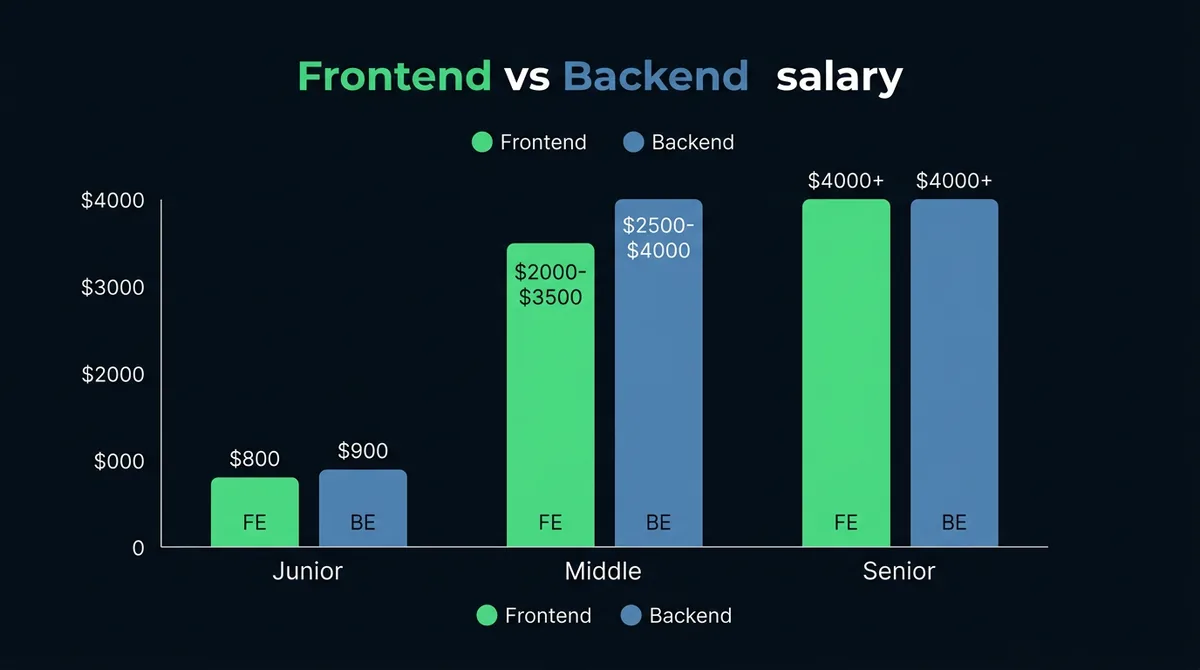
Salary bands from DOU (Ukrainian market context): junior frontend from about $800, junior backend from about $900; mid frontend roughly $2,000–3,500, mid backend roughly $2,500–4,000; senior tracks for both often start around $4,000+. The junior gap is small; from mid onward backend averages a bit higher — with fiercer competition for the best seats.
How frontend and backend cooperate: what an API is for
Frontend and backend are not isolated worlds. They constantly exchange data through an API (Application Programming Interface). When you submit a login form, the frontend sends a request through the API. The backend checks credentials, issues an auth token, and responds. The frontend stores the token and renders your profile.
That dialogue can happen hundreds of times per session — loading catalogues, placing orders, updating settings. For a deeper technical framing, see AWS on frontend vs backend and the Wikipedia article on front end and back end.
Practical takeaway for choosing a path: both sides should understand APIs even if they only implement one tier. A frontend developer who does not grasp HTTP and JSON response shapes stalls at “layout engineer”. A backend developer who ignores how the UI will consume an API ships awkward contracts that slow everyone down.
According to the Stack Overflow Developer Survey 2023, nearly 60% of developers blend both directions — proof that the classroom wall between “front” and “back” is blurrier in production than in syllabi.
What to choose: a practical take without romance
If you want a single answer to “which is better?” — there is not one. But there are heuristics that help you pick what fits.
Choose frontend if you need visible results fast. You write code and immediately see a button change colour or a card animate. That tight feedback loop is motivating early on. If you care about design, UI clarity, and the idea of “making it good for humans”, you will feel at home. Frontend also tends to be the faster on-ramp: with HTML, CSS, and JavaScript basics you can ship a first project within a few focused months.
Choose backend if logic beats pixels for you. If you enjoy algorithmic puzzles, database internals, and how a system survives thousands of concurrent requests, this is your lane. The entry is steeper, but strong backend engineers stay scarce. Career ladders often branch toward DevOps, cloud (AWS, GCP), and systems architecture.
If you truly cannot decide — start with frontend. Not because it is “easier” in every dimension (though the floor is lower), but because you will quickly learn whether writing code at all clicks for you. Many people who began with layout moved to backend or full stack after a year or two.
Full stack is its own path for builders who want both layers — especially in startups and MVPs where one engineer covers UI and server. Real full stack depth takes years, not a shallow “I touched both” course. If you want a from-zero narrative, read our guide to web development from scratch — from first steps to first projects.
Outlook and the 2026–2027 market: where the opportunity is
Frontend moves fast — that is both fuel and fatigue. New frameworks, React releases, Server Components, meta frameworks like Next.js: the conveyor never stops. If you like staying current, you will thrive. If you want to “learn once forever”, frontend will keep asking for updates.
Backend feels steadier. Java has decades of industrial mileage. PostgreSQL is not going anywhere. Algorithms and design patterns age slowly. That can feel like solid ground for deep expertise instead of endless chasing.
Demand exists on both sides. Any team shipping a website or web app needs frontend and backend talent. The question is not “where are more openings?” but where you can grow and stay motivated for years.
One under-discussed tie-in: SEO partially depends on frontend quality. Semantic markup, load speed, and rendering behaviour all influence visibility. If you are curious what SEO is and how technical choices affect Google, that is direct overlap with frontend engineering.
What practitioners argue in the community
In real developer discussions — for example across threads on Reddit r/webdev — experienced builders often repeat a point rarely found in beginner articles: the boundary between roles keeps softening, and understanding both sides is a competitive edge even if you specialise.
FAQ
Short answers to common beginner questions. The long-form version lives in the sections above.
- What is frontend in simple terms? Everything you see and click on a site or app — buttons, menus, forms, motion. Client-side code running in your browser.
- What is backend? The server side: data processing, databases, authentication, business rules. Invisible to users, but indispensable.
- How does day-to-day work differ? Frontend ships UI/UX, frameworks, and browser performance. Backend ships logic, storage, APIs, scalability, and security.
- Which is easier to learn? Frontend shows results immediately; backend needs architecture and data thinking sooner — often with less crowded junior pools.
- Can one person do both? Yes — that is full stack, but depth takes years, not a surface tour of two tracks.
- Best starting track in 2026? Fast feedback and motivation → frontend. Logic and data → backend. Both remain hireable.
- Why should both sides know APIs? They are the bridge between tiers; without HTTP and JSON literacy you cap your growth in either role.
Closing thoughts
Frontend and backend are not rivals — they are two halves of one product. A polished UI without a reliable server is a beautiful empty storefront. A rock-solid backend without thoughtful frontend is power that is painful to use. Modern applications live at their intersection.
If you are still undecided — start writing code. Your first lines will teach you more than another “which track” article. Once you feel the pull, go deep and aim for mastery instead of permanent beginner breadth.

You may also like

Need a site or app and want the right roles on the team?
We clarify the product, stack, and who you actually need — without hiring theatre for its own sake.