Clients ask me the same question over and over: "We shipped solid content and fixed the technical basics — why are we still not in the top results?" Almost every time the answer is the same. Either there are no quality backlinks, or the ones you have are so weak that you would be better off without them.
Link building is the process of earning hyperlinks to your site from other domains. It sounds simple. In practice it is one of the slowest, hardest disciplines inside what SEO means — it punishes rushed work and can cost you months of traffic when you get it wrong.
If you want vendor-neutral primers, Semrush and Yoast publish deep guides that practitioners worldwide still reference.
Why links still matter
When Google launched, its founders treated a hyperlink as a vote of confidence. More votes — especially from credible sources — meant a stronger page. That idea became PageRank, the seed of the entire ranking stack.
The algorithm is thousands of times more nuanced today, but the core mechanic never disappeared. Links from trusted, relevant sites remain one of the loudest off-page signals, and Google has repeatedly acknowledged their importance in official documentation.
Link building for SEO is not "collecting as many URLs as possible". It is digital reputation work. When authoritative sites in your niche cite you, you look authoritative. When only spammy directories or doorway farms point to you, you look like spam. Harsh, but accurate.
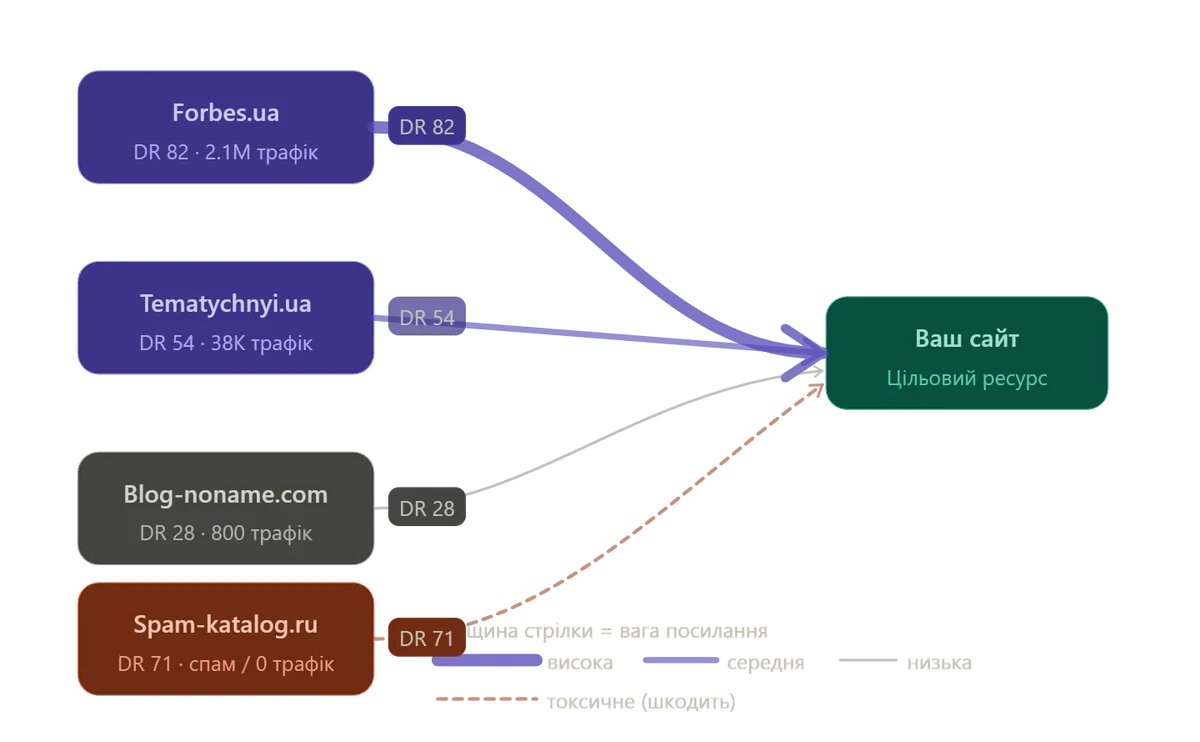
Link types: what passes weight — and what does not
First principle: hyperlinks are not interchangeable. There is a real technical gap between them, yet beginners often ignore it and then wonder why "we bought a hundred links and nothing moved".
Dofollow is the default state — no extra rel attributes. It passes link equity (often called link juice) from donor to acceptor and is what most ranking discussions mean by a "real" backlink. For sustainable SEO you still want editorial, traffic-rich donors rather than ghost sites on autopilot.
Nofollow adds rel="nofollow" to tell crawlers not to treat the hop as a PageRank transfer. Newsrooms use it constantly. You may not get direct ranking juice, but you can still earn clicks and keep your overall profile looking human. Avoiding nofollow entirely is unnatural.
Sponsored and UGC are Google's newer hints (2019+) for paid placements and user-generated blocks respectively. Treat them as transparency tools: they may not behave like classic dofollow votes, but context still matters to the classifier.
Anchor text deserves its own essay. Exact-match anchors can reinforce relevance, but when eighty percent of your profile uses the same money keyword, Penguin-style systems read that as manipulation. Natural mixes include branded phrases, naked URLs, generic ("read more") phrases, and occasional topical phrases in editorial context.
Need a backlink audit or a white-hat plan?
We review donors, anchors, and risk — no black-hat shortcuts or "top rankings in a week" fairy tales.
Talk to usHow Google ranks websitesWhite hat vs black hat: the method beats a short-lived spike
Grey-market tips from link sellers and advice from people who ship durable products might use the same words, but they are different rulebooks.
White hat maps to Google's published expectations: real guest posts, editorial outreach, thoughtful participation in communities, and assets that earn citations because they are useful. Slow, expensive — and resilient when the next core update lands.
Black hat is the shortcut aisle: bulk buys, private blog networks where one owner interlinks a fleet of sites, automated blasts, link dumps. You may spike fast — sometimes frighteningly fast — and then a Penguin-class refresh arrives and wipes the visibility just as quickly. I have seen recoveries take six to twelve months after those mistakes.
There is also a grey band: sponsored placements on legitimate publishers, or reciprocal agreements between real partners. Google's policies still call out paid links meant to manipulate PageRank, yet many above-board campaigns look like normal marketing when disclosure, relevance, and audience fit are honest. The danger zone is obvious advertorials on zero-traffic scraper domains — that is only a matter of time.
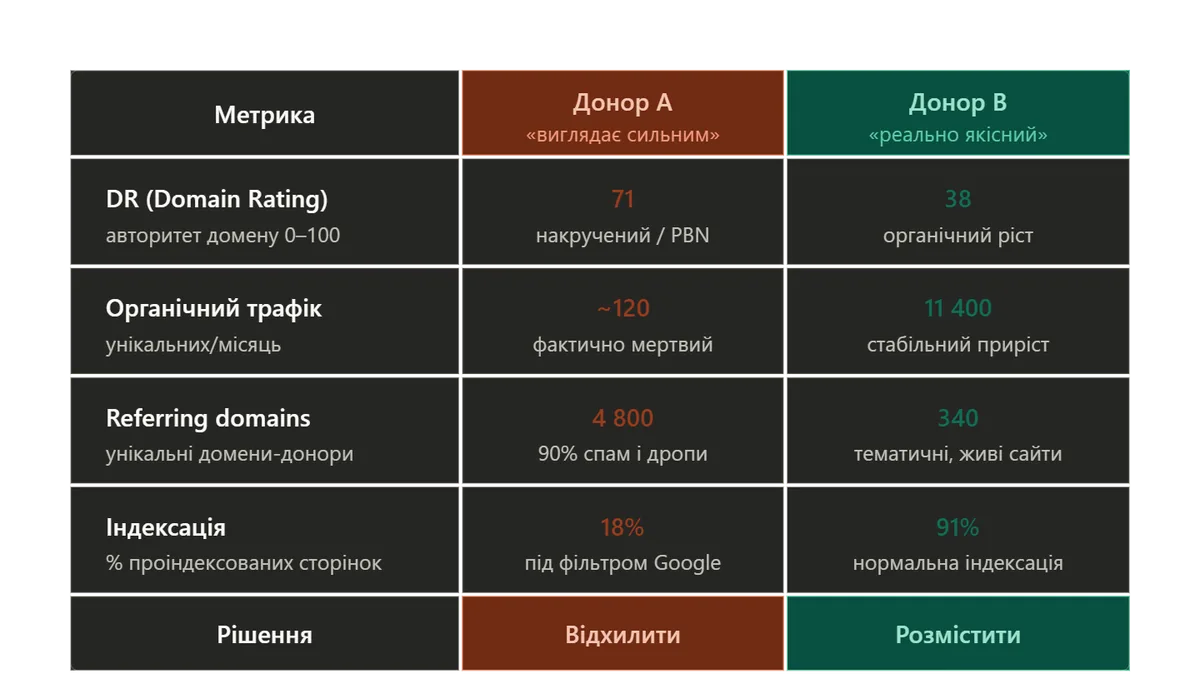
How to vet a donor: metrics that deserve trust — and scepticism
A link builder lives in spreadsheets and inboxes: yes or no on this domain, what anchor to use, what price is sane. Those calls should lean on metrics — but only when you know how to read them.
DR (Domain Rating) from Ahrefs is a zero-to-one-hundred view of a domain's inbound link graph. DR 50+ is a useful rule of thumb for many verticals. DR 70 paired with zero organic traffic is a red flag: either the metric is inflated or the site is a zombie.
DA (Domain Authority) from Moz chases a similar idea with a different model. Expect DR and DA to disagree for the same hostname — that is normal, not a bug.
Referring domains counts unique sites pointing in. One donor firing a hundred sitewide footers is not the same as a hundred independent endorsements. Engines weight breadth, not raw duplicate count.
Organic traffic is the honesty check. If people still find the site through search, it is alive, indexed, and less likely to be a burned asset. Ahrefs and SimilarWeb only approximate traffic (sometimes wildly), but trend lines still help.
Indexing health matters too. When only a fraction of a large domain is indexed, something is off — thin content, technical debt, or a penalty. Buying links from that donor is a gamble, not an investment.
Acquisition tactics that still work
Dozens of tactics exist. Here are the ones that move the needle without reckless manipulation.
Outreach is direct pitching to editors or owners: guest posts, sponsored features, leased mentions, or co-created research. It is transparent and labour-intensive — inboxes ignore you, pricing swings from tens to hundreds of dollars per market, and some regions only answer in messengers.
Crowd marketing means contributing where your buyers already talk — forums, Q&A threads, niche communities. Cheap or free, but spammy one-liners get deleted and can trash your brand. Good crowd work reads like help first, link second.
Content-led magnetism is the slow burn: proprietary data, exhaustive guides that beat every SERP competitor, visuals journalists can embed. Those assets keep earning links for years — if you fund the research and design upfront.
Broken link building finds dead outbound links on authoritative pages and offers your resource as a replacement. Huge in English-language SEO, underused in UA markets — yet the value prop is simple: you help someone fix a 404 without opening with a cash invoice.
Mistakes that cost rankings
Some look obvious, yet I still see them in otherwise mature teams.
- Velocity spikes — hundreds of new backlinks in weeks on a fresh domain — look manufactured. Growth should resemble a curve, not a cliff.
- Monochrome profiles where ninety percent of anchors or donor types match a single template scream automation. Natural graphs mix anchors, industries, and placement types.
- Topic mismatch: a toy shop earning mass links from crypto blogs wastes budget at best and invites negative signals at worst.
- Sitewide footer widgets across thousands of templated pages dilute each hop toward zero — engines have discounted that pattern for years.
FAQ
What is link building in simple terms?
It is the practice of earning hyperlinks from other websites to yours. Each credible endorsement tells search engines that your site can be trusted on a topic. More high-quality endorsements generally correlate with stronger visibility — assuming on-page and technical foundations are solid.
What does a link builder do?
They own the off-site roadmap: competitor gap analysis, prospecting, negotiation, placement QA, anchor governance, and reporting on toxicity or velocity risks.
Can you buy backlinks?
Google forbids paying for links meant to manipulate PageRank and can penalise obvious abuse. Many legitimate marketing packages still include links when the story, audience, and disclosure are real. Risk explodes when you buy bulk mentions on irrelevant networks with over-optimised anchors.
How long until backlinks affect rankings?
Expect weeks to months depending on crawl cadence, donor strength, and how contested the SERP is. A national media pickup can move metrics quickly; a buried forum signature might never matter.
What are dofollow and nofollow links?
Dofollow is the default followable link that passes authority signals. Nofollow adds rel="nofollow" (or equivalent hints) to suppress that transfer while still allowing clicks and brand exposure.
How many links do you need to rank #1?
There is no universal quota. Reverse-engineer whoever already owns the SERP: referring domains, quality mix, geography, velocity. Your roadmap should chase that competitive envelope, not a magic integer.
Can you earn links for free?
Yes — thoughtful community answers, legitimate directories where they still matter, Google Business Profile, partner exchanges, and link-worthy research all exist without a line item labelled "buy link".
How do you spot a toxic backlink?
Watch for donors with no organic traffic, random topical pairings, ad-stuffed templates, violent link-graph spikes, or countries that do not match your market. After a careful audit you may disavow truly toxic patterns, but disavow is a scalpel, not a default button.
Closing thoughts
Backlinks are not arcade power-ups. They are reputation signals that accrue slowly and can collapse overnight when you cheat the rules. Sustainable link building rewards teams that respect the algorithm — not teams trying to brute-force it.
For conceptual history, Wikipedia's link building overview is a decent orientation map. For execution, combine Ahrefs, Serpstat, or SimilarWeb exports with old-fashioned judgement every time you evaluate a donor.
Want help shaping your link strategy?
Reach out — we will map a realistic plan for your niche, risk tolerance, and budget.
ContactWhat SEO is — baseline guide
You may also like
Need a backlink audit or a white-hat link plan?
We review donors, anchors, and risk — without black-hat shortcuts or “#1 in a week” promises.