Every time someone types a query into the search bar, Google scans billions of pages in fractions of a second and decides who ranks first and who ends up on page five where almost nobody looks. That system is called ranking. If you are working through what SEO is, understanding its mechanics is not just useful — it is essential.
I wrestled with this for a long time — first in theory, then on real projects where mistakes were measured in lost traffic and leads, not points. Here is the distilled version.
What ranking is and why it exists
Ranking is the process of ordering pages in search results from most to least relevant for a specific user query. In plain terms: Google decides which page best answers the question — and shows it first.
What does ranking mean in practice? It is not just a "position in a list". Behind every position sits an evaluation of hundreds of signals: how useful the page is, how authoritative the site is, how fast it loads, how people behave after they click. The ranking algorithm is a complex model that weighs those factors at once and outputs the SERP you see.
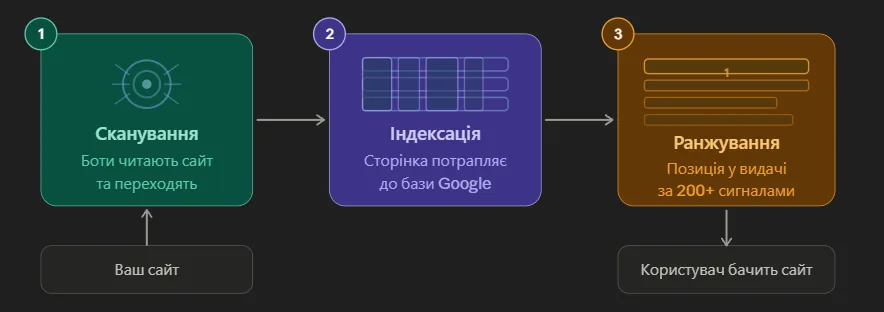
Ranking in Google starts long before anyone types a query. The site must be crawled, indexed — only then does it enter the candidate pool for results. If any of those steps is broken, the site effectively does not exist for search, no matter how good the content is.
For Google's own explanation of how this works, read the documentation on ranking systems— it lists the major systems and what they aim to do.
How algorithms evolved: a short history
You cannot understand modern ranking without context. In the early 2000s algorithms were crude: more keyword mentions often meant higher positions. That spawned an entire spam industry: keyword-stuffed copy, hidden text, link farms.
Google responded in waves. Florida (2003) introduced a serious anti-spam filter and hit keyword stuffing. Panda (2011) tore down content farms with thousands of thin pages. Penguin (2012) targeted manipulative links. Hummingbird (2013) changed the logic itself: instead of matching exact words, the system began to infer query intent.
That is when SEO stopped being a game of keywords and became a game of meaning. Writing "for the crawler" became ineffective — and harmful. Writing for people became the only sustainable strategy.
Today's systems judge text quality, understand context, and evaluate real user behaviour on the page. And they keep changing — hundreds of updates per year, some invisible tweaks, some broad Core Updates that reshuffle entire niches.
Key Google Search updates — 2003–2023 (selected milestones)
| Year | Area | Update | What it did |
|---|---|---|---|
| 2003 | Core | Florida | First large update penalising aggressive exact-match keyword tactics. |
| 2011 | Quality | Panda | Hit low-quality content, thin pages, and duplication at scale. |
| 2012 | Spam | Penguin | Targeted manipulative links, paid schemes, over-optimised anchor text. |
| 2013 | Core | Hummingbird | Semantic search and intent instead of raw keyword matching. |
| 2015 | Mobile | Mobilegeddon | Mobile-friendly as a ranking signal; start of the mobile-first era. |
| 2015 | Core | RankBrain | Machine learning among top signals; better handling of unseen queries. |
| 2018 | Quality | Medic | YMYL niches saw stricter E-A-T expectations (health, finance, law). |
| 2019 | Core | BERT | Deeper understanding of natural language and context in queries. |
| 2021 | Speed | Page Experience / CWV | LCP, FID, CLS as signals together with HTTPS and layout stability. |
| 2022–2023 | Quality / AI | Helpful Content | Focus on people-first content; E-E-A-T; pushback on low-value AI spam. |
Caption: From fighting spam to judging real usefulness.
Need an audit or a growth plan?
We review technical health, keywords, and competitors — without "#1 in a week" promises.
Talk to usSEO & support servicesCore ranking factors: what actually moves the needle
Google has never published a complete list of signals — there are 200+ and their weights shift constantly. But from official guidance and years in the field, a few clusters explain most outcomes.
Relevance and content quality
The foundation. The page must answer the query fully, accurately, and better than competitors. This is not about word count — I have seen 500-word pages in the top three and 5,000-word pages go nowhere. The question is whether the visitor finds what they searched for. Systems like RankBrain and architectures such as MUM analyse semantic context, not raw keyword repetition — so "keyword stuffing" no longer saves weak pages.
Critical on-page signals include the primary query in Title and H1, natural use of related terms in the body, clear structure with H2–H3 headings, and optimised images with meaningful alt text.
Technical health
Without a solid technical base, everything else fights uphill. Technical ranking factors include page speed (Google officially uses Core Web Vitals: LCP, FID, CLS), a correct mobile experience (mobile-first indexing is the default), HTTPS, clean architecture without broken links and redirect chains, and well-configured robots.txt and sitemap.xml.
On one project we grew content and links for three months while positions barely budged. The culprit: a staging site was indexable and Google was picking up duplicates. One technical bug swallowed the whole effort.
Authority: links and E-E-A-T
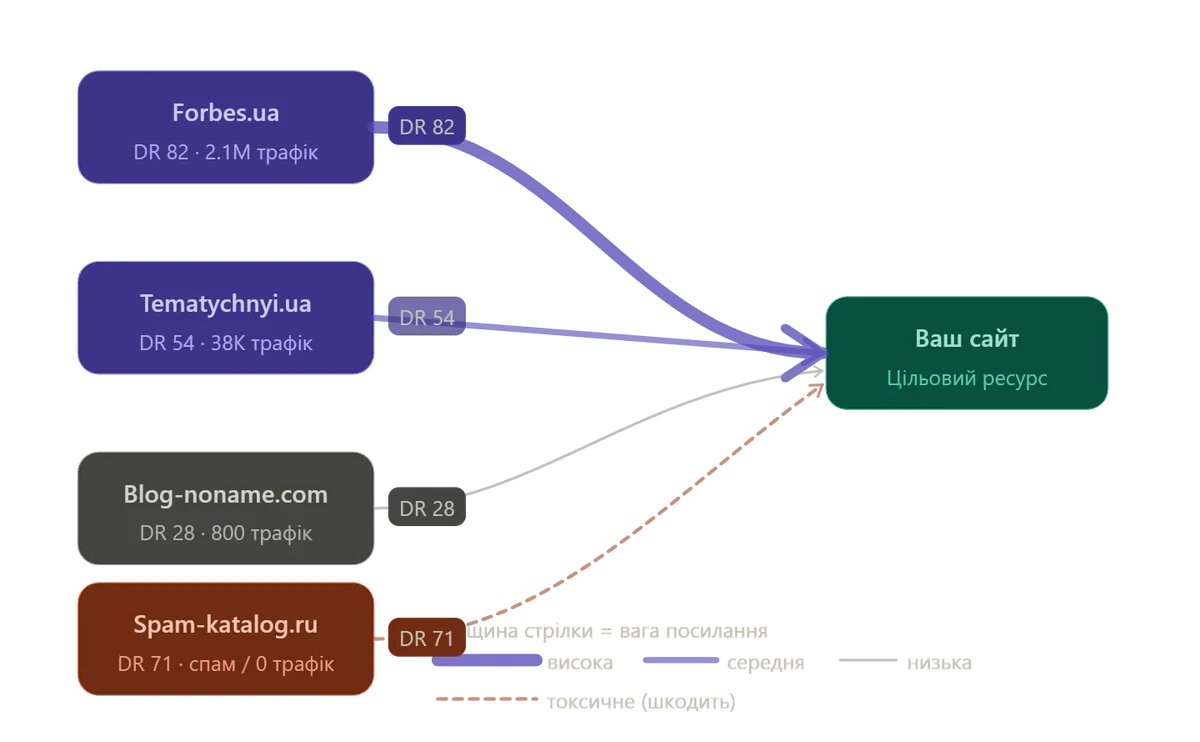
Backlinks are trust votes from other sites. But "more is better" died with Penguin. Ten links from real, topical sources usually beat a hundred spammy directory links. The model looks at donor authority, topical fit, anchor text, and placement on the page.
In parallel Google increasingly weighs E-E-A-T (Experience, Expertise, Authoritativeness, Trustworthiness): who wrote the piece, whether expertise is verifiable, and whether the site is trustworthy overall — especially in medicine, finance, and law.
Behavioural signals
SERP CTR, time on page, depth of visit, bounce patterns — all hint whether people were satisfied after the click. If someone returns to the search results within seconds, that pogo-sticking pattern hurts. If they stay and browse, it helps.
Local and brand signals
Google Business Profile, reviews, branded searches, and unlinked brand mentions on reputable sites all build brand authority that complements classic link building.
Five pillars of how Google ranks sites
| Pillar | What Google evaluates | Example signals |
|---|---|---|
| Content | Quality, relevance, E-E-A-T | Helpful content, semantics, uniqueness, depth, freshness |
| Technical | Speed, indexing, structure | Core Web Vitals, HTTPS, mobile-first, crawlability, schema, sitemap |
| Links | Authority, quality, anchors | Backlinks, domain strength, anchor text, nofollow mix, diversity |
| Behaviour | CTR, time on site, exits, depth | CTR, dwell time, bounce rate, pogo-sticking, scroll depth |
| Brand | Recognition, branded demand, presence | Branded search, NAP consistency, Knowledge Panel, mentions |
Brand is a long-term trust signal. Branded searches read as proof of authority. Strong brands can win even with fewer raw backlinks.
Prior and multidimensional ranking
Two ideas people often confuse — worth separating clearly.
Prior (a priori) ranking signals describe the baseline authority a site earns before a specific query is evaluated: domain history, overall link profile quality, technical hygiene, historical engagement. Classic PageRank at its simplest is an example. Sites with a strong prior profile often rank new queries faster because Google already trusts them.
Multidimensional ranking means the algorithm weighs dozens or hundreds of signals from different dimensions — content, technical, links, behaviour, local — at once. There is no single silver-bullet factor; winners tend to be strongest in aggregate. That is why brilliant copy on a broken site can lose to a mediocre page on a technically clean domain, and vice versa.
Understanding that multidimensionality is the key to diagnosis: if growth stalls, look for the weak dimension, not a magical single tweak.
What reliably hurts rankings: anti-patterns from the field
- Keyword stuffing reads as spam and triggers downgrades.
- Duplicate or near-duplicate content across your own URLs dilutes signals and confuses canonical choice.
- Sudden unnatural link spikes can still look like manipulation to Penguin-style systems.
- Aggressive interstitials that hide the main content on mobile harm both UX and evaluations.
- Slow LCP (for example above ~4s) is a concrete negative in the Core Web Vitals era.
FAQ
What is ranking in a search engine?
Ranking is the ordering of indexed URLs in the SERP by relevance to the query. Google scores each candidate with hundreds of signals and orders them from most to least useful for that search.
How many ranking factors does Google use?
There is no public exhaustive list; practitioners commonly cite 200+ signals across content, technical, links, behaviour, and brand dimensions. Weights change with every core update.
Do keywords still matter in 2026–2027?
Yes, but not the way they did twenty years ago. The system infers intent and meaning. Keywords still belong in Title, H1, and body copy — naturally. Over-optimisation hurts more than it helps.
What is prior (a priori) ranking?
It is the baseline trust and authority Google associates with a site independent of a single query: history, link graph quality, technical health, engagement history. Strong priors make new keyword targets easier to rank.
How fast do rankings change after optimisation?
It depends on competition and what changed. Technical fixes can show within weeks. Content plus links often need 2–4 months. Large authority shifts can take six months or more.
Does position #1 guarantee stable traffic?
No. Algorithms change, competitors move, query demand shifts. Holding top spots requires ongoing care: refresh content, monitor technical health, and keep earning trust. SEO is a marathon.
What is multidimensional ranking?
It is the principle that Google scores pages across several independent dimensions at once. The winner is rarely perfect in only one dimension — it is strongest overall.
Conclusion
Ranking in Google is neither lottery nor black box. It is an evolving system with a clear goal: surface the most useful, authoritative, and technically sound answer for each query.
The ranking stack keeps moving with user behaviour and technology. Short-term tricks age badly. Teams that understand the factor landscape and work on it systematically earn durable traffic — the kind that does not vanish the moment ad spend stops.
Want a plan tailored to your niche?
Reach out — we will propose realistic priorities without magic formulas.
ContactWhat SEO is — primer
You may also like
Need an audit or a growth plan?
We connect technical health, content, and authority so rankings work for you — with clear reporting.