This article is not about syntax. Millions of pieces already cover syntax, and you will find them. It is about how to actually enter the profession and not fall apart along the way.
What web development is and why it matters to you
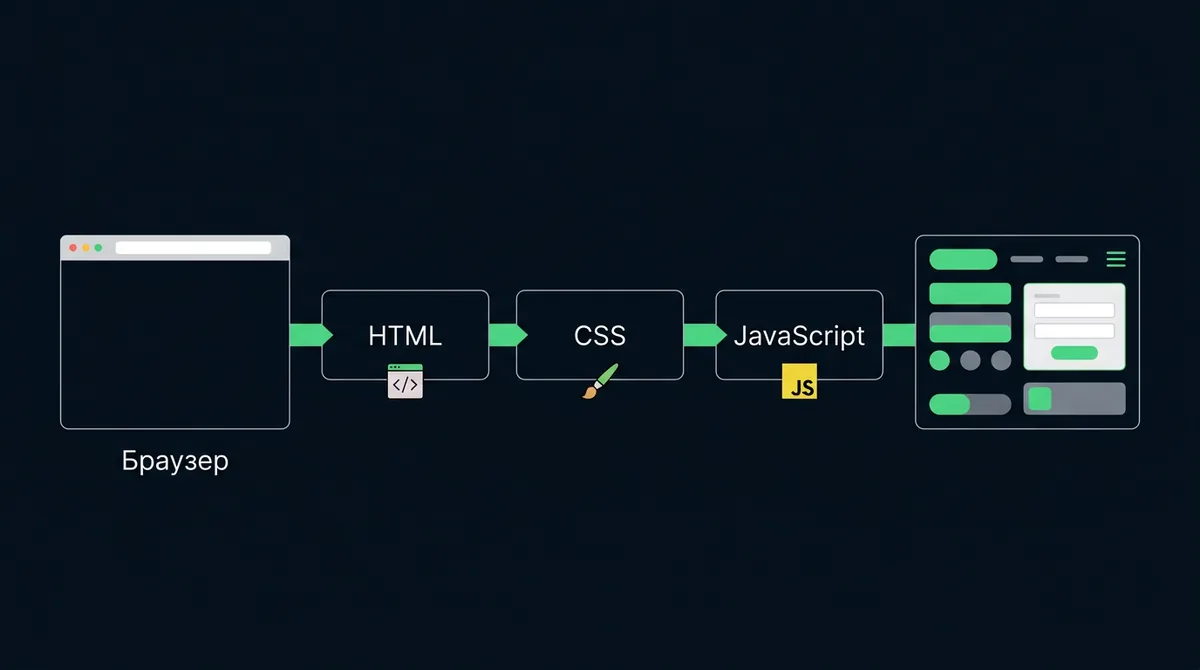
Web development is building everything that lives in the browser. Every site, every web app, every “buy” button is someone’s work. Inside the field there are three big zones.
- Frontend — what the user sees: layout, animations, forms, navigation. A frontend developer works with HTML (page structure), CSS (look and feel), and JavaScript (interactivity).
- Backend — logic behind the scenes: servers, databases, authentication, APIs. People use Python, PHP, Node.js, Ruby, and other languages.
- Databases — storage for everything: users, orders, comments, settings. Most sites simply cannot work without them.
Most beginners start with frontend — and that is the right call. You get instant visual feedback, which is critical early on when motivation is still fragile.
Web development is one of the few careers where, in a reasonable time, without a university degree and without huge investment, you can reach a level people pay well for. The barrier to entry is real, but it is not impossible.
Need a site or web application?
While you learn the basics, we are already building. Order development at becode.tech and get a shipped product in the shortest agreed time.
Request developmentBrowse servicesFirst rule: pick one direction
This is where most people stumble at the very start. They try to “become a web developer in general” — watch HTML videos, then Python, then read they must know React, then hear about Rust — and a month later they know a little about everything and nothing properly.
Web development is huge. Trying to swallow it whole will crush you before you ship your first real project. Someone who knows one stack deeply is worth far more than someone who has skimmed ten.
After you have the basics of HTML and CSS, pick one track and stay on it. If you like seeing results visually: frontend → JavaScript → one framework (React or Vue). If you prefer data and logic: backend → Python or Node.js.
Switching from one language to another is nothing compared to the gap between “I cannot code” and “I can”. Start with anything sensible.
A concrete plan: what to do step by step
How not to burn out: rhythm and expectations
Here is what few people tell beginners honestly: learning progress is uneven. At first everything feels great — first page, first button, first script, and it feels rewarding. Then comes the plateau. For weeks it feels like you are standing still. That is when most people quit.
The fix is simple but needs discipline: do not obsess over outcomes — obsess over time. Block the same window every day — twenty minutes or an hour — and show up. It does not matter how “productive” the session felt. It matters that it happened.
Satisfaction comes from keeping the rhythm, not from unpredictable breakthroughs. New horizons open as a pleasant side effect, not as a moving target you chase.
Not sure how to start your project?
A free consultation with our specialist — we will discuss your goals and suggest the best fit for your business.
Book a consultationSoftware: what to install on your computer
Serious work needs a proper computer — Windows, Mac, or Linux, all are fine. A phone is not enough for development. On day one you only need a few tools:
Vibe coding: why AI will not teach you to program
It is trendy to paste a task into ChatGPT or another model and get finished code — people call that “vibe coding”. For an experienced developer solving a specific task, it is a great tool. For learning, it is a trap.
When AI writes code for you, you do not understand what is going on. It runs — but you do not know why. When something breaks (and it will), you cannot fix it. Real learning is writing every line yourself and knowing what it means.
Use AI as a smart dictionary: “explain this line”, “why does this function fail”. Not as a substitute for thinking — or you will depend on it forever.
Where to learn: knowledge bases and communities
There is so much learning material that abundance itself becomes a problem. Here are resources that hold up:
For fundamentals:
For practice and experiments:
Instead of a conclusion: start today
I could write something inspiring about the job market and demand. It is more honest to say this instead.
Most people who “want to become web developers” never become one. Not because it is too hard. Because they keep reading articles instead of opening an editor and typing the first tag.
Open Visual Studio Code right now. Create index.html. Write <h1>Hello, world</h1>. Open it in the browser. You have already done more than most people who are “about to start”.
It will get harder. There will be stretches where nothing works and you do not know why. If you practise every day — even a little — in a few months you will look at your first code and be surprised how far you have come.
Do not wait for the perfect moment, course, or mentor. Start with what you have. The rest follows.

You may also like
Ready to launch your web project?
You have seen how web development works from the inside. Now trust a team that does it every day — with quality and clear timelines.