SEO stands for Search Engine Optimization. Three words that sound simple. In reality — they are not.
Behind the acronym sits a whole way of thinking about how search works and why some sites keep pulling traffic for years while others — with the same budget and a similar product — stall somewhere on page five and wait for a miracle. I have been through dozens of such projects. I have seen both endings. Every time I am convinced: the gap is not in the budget or even the niche — it is in understanding how this actually works.
What SEO is and why you need it at all
Promoting a site is not a one-off campaign and not a button that “turns on traffic”. It is a set of internal and external optimisation work whose goal is to build a stable presence in organic search for queries that actually bring buyers.
What is SEO in simple terms? It is about helping Google understand your site better than it understands your competitors' sites — and showing it first to the people who are searching right now for what you sell or offer.
SEO is definitely not “stuff keywords into copy” and not “buy links from exchanges”. I have met clients who paid vendors for exactly that for years — and got either zero impact or a Google penalty as a bonus. Good SEO is work on four fronts at once: technical health, relevant expert content, domain authority in the engine's eyes, and usability for real people who land on the page.
Without SEO, even a strong product stays invisible. My favourite analogy: imagine a Michelin-star restaurant with no address, no sign, and no map listing. That is what a good site without optimisation looks like — it exists, but nobody can find it.
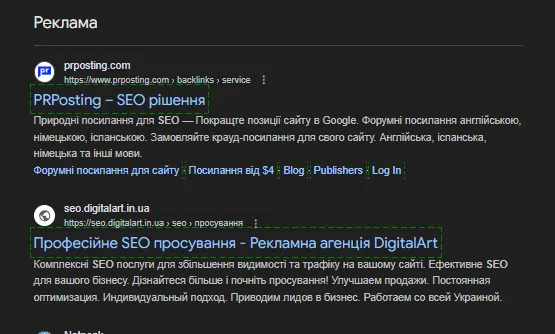
The clearest and most authoritative explanation of how Google evaluates sites is in Google's official SEO Starter Guide. I recommend it as the primary source — no middlemen, no guesswork.
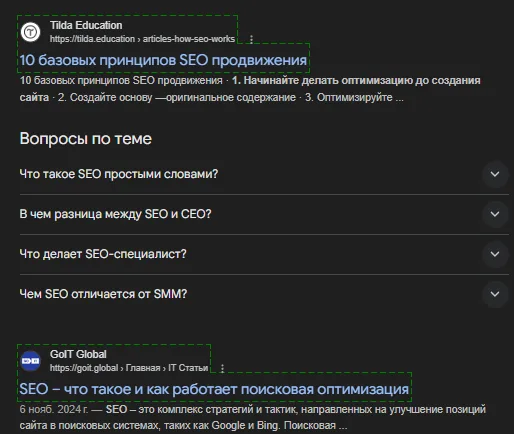
Need an SEO audit or ongoing promotion?
We review technical health, keyword strategy, and competitors — and propose a realistic plan without “#1 in a week” promises.
Discuss SEOSEO & support servicesGoals of search engine optimisation
Before touching any promotion work, I always start with one question for the client: “Why do you want SEO? What outcome would you call success?” That is not rhetoric — without clear goals you cannot build a strategy.
Typical business goals for SEO include:
- Rank in the top positions for priority commercial queries (specific rankings for your key terms).
- Grow organic traffic — people arriving from search without paid ads.
- Improve conversion — turn more visitors into buyers or qualified leads.
- Lower customer acquisition cost compared with paid search over the long term.
- Increase brand awareness — even if someone does not click today, they saw your name and remember it.
In practice I see two client types: those who want to “be first on Google” — which is achievable — and those who want sales growth. Smart teams realise the first does not automatically deliver the second. Between a top ranking and real profit lies a whole chain: a page that loads in a second, clear copy, a visible “buy” button, trust in the brand. SEO opens the door. The site has to do the rest.
How Google decides who ranks first: three stages
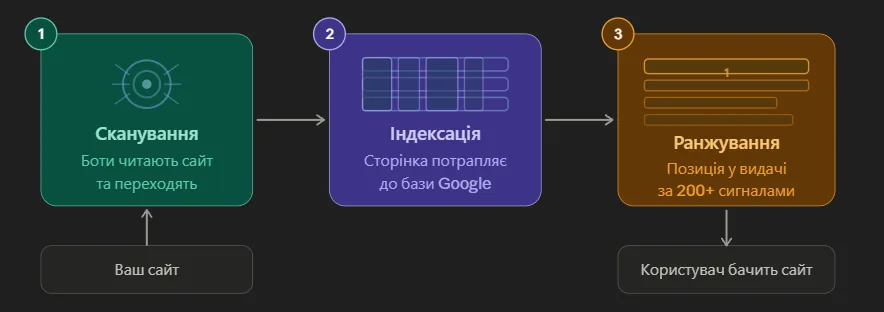
To understand SEO mechanics, you need to see how a search engine processes sites. Roughly, the pipeline has three phases.
Crawling. Search bots crawl the web by following links. They read code, text, and structure. If your site is technically broken or blocked from indexing, bots may never learn it exists.
Indexing. After crawling, a page lands in Google's huge index — like a library with billions of books sorted by topic. At this stage the algorithm answers one key question: what is this page about — and who would it actually help?
Ranking. This is where it gets interesting. Someone types a query — and within fractions of a second the algorithm scans millions of indexed URLs, scores them with 200+ signals, and orders the results. Technical quality, depth and trustworthiness of content, quantity and quality of backlinks, behaviour of previous visitors — all of that feeds the final position, with weights that vary by niche, competition, and query type.
Go deeper: how Google ranks websites — signals after indexing, how major updates reshaped SEO, the five evaluation pillars, and anti-patterns from real projects.
Core SEO building blocks: what actually moves rankings
Technical SEO — the foundation; without it the rest is wasted
In my experience, most sites that “do not grow” despite content and links have serious technical debt: slow loads, duplicate URLs, bad redirects, missing HTTPS, a staging site left open to indexing — all of that quietly eats potential rankings, often with no warning in the dashboard.
Technical SEO covers: page speed — Google officially uses Core Web Vitals, and LCP above ~2.5s is already a red flag; correct behaviour on mobile (mobile-first indexing is the default, not an option); clean markup; proper robots.txt and sitemap.xml; fixing 404s and redirect chains where every extra hop leaks link equity.
You can sanity-check technical basics for free in Google Search Console — it is the first tool I connect on every new project, before anything else.
On-page SEO
On-page work is everything that happens inside the site: content quality, meta tags, headings, URL structure, internal linking. It is critical not to confuse “optimised copy” with “copy stuffed with keywords” — they are completely different things.
SEO copy is material that answers a real user query as fully and usefully as possible, naturally includes relevant terms, and is formatted for easy reading and scanning (H1–H6, paragraphs, lists, images with captions).
On-page essentials for every important URL:
- Title — the headline shown in the browser tab and in results. It should include the primary keyword and invite a click.
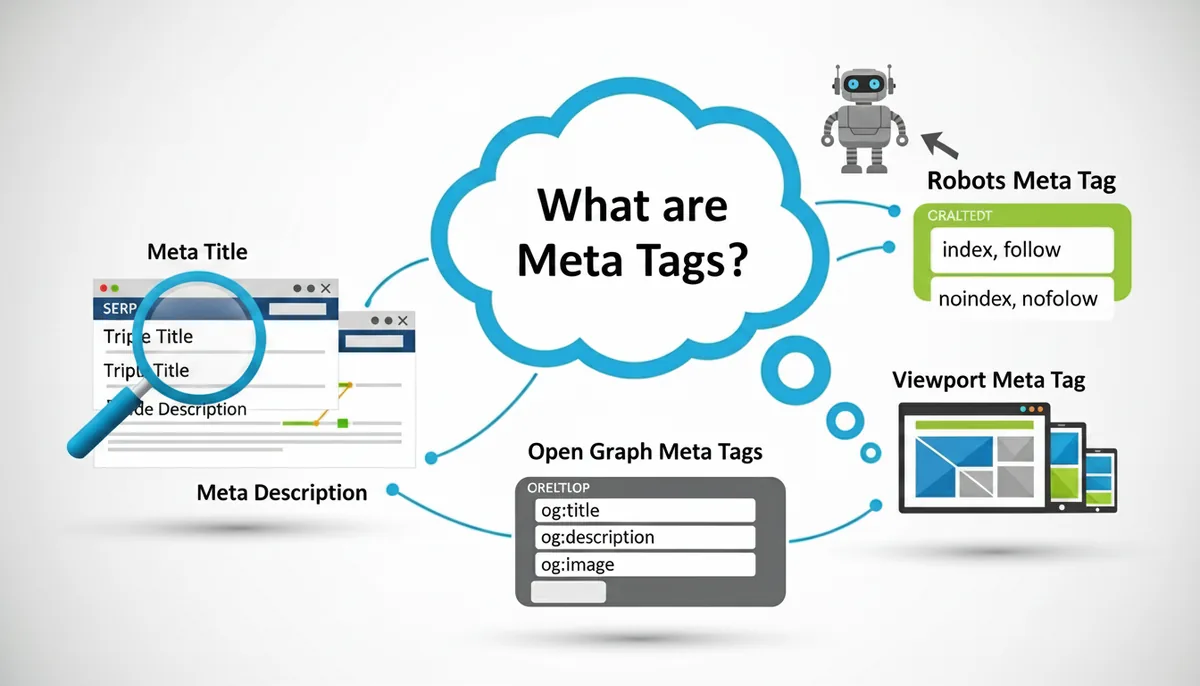
- Meta description — the short blurb that shapes the snippet. It is not a direct ranking factor, but it strongly affects CTR.
- H1–H6 headings — a logical outline. One H1 per page, aligned with the main query.
- Schema.org markup — structured data that tells the engine what is on the page: product, review, recipe, organisation, article, and so on. I always implement markup where it fits — it can produce rich results (stars, prices, event dates) and lift CTR even without a better position. Core Title and Description meta tags — in the meta tags guide.
- Image optimisation — compression for speed, meaningful alt text (both an SEO signal and accessibility).
- Internal linking — links between pages spread authority and deepen engagement.
E-E-A-T: why Google trusts some sites more than others
This is where many SEOs still under-deliver. E-E-A-T is the framework Google references in quality-rater documentation: Experience, Expertise, Authoritativeness, Trustworthiness — four lenses the engine uses to judge whether a site is a credible source or just a pile of optimised text.
Google does not merely parse keywords. It tries to infer who wrote the material, whether they have real expertise, and whether the site is trustworthy overall. That bar is especially high in YMYL topics (Your Money Your Life) — health, finance, law, safety. There, low-authority content rarely reaches the top, no matter how many keywords you add.
Here is how it played out in practice. On one medical niche project we hovered around positions 8–15 for months. After we added physician bios with links to official medical registries and implemented Person and MedicalWebPage schema, several URLs reached the top five within two months — with no new backlinks. Google finally “saw” who stood behind the content.
Concrete E-E-A-T signals: an About page with real people and roles; bylines with author names and short bios; client reviews, ideally verifiable; clear contacts, legal info, privacy policy; brand mentions on respected industry sites.
For a deeper, technical take on authority and E-E-A-T, see Ahrefs' “What is SEO” — one of the most rigorous guides in the industry.
Off-page SEO and link building
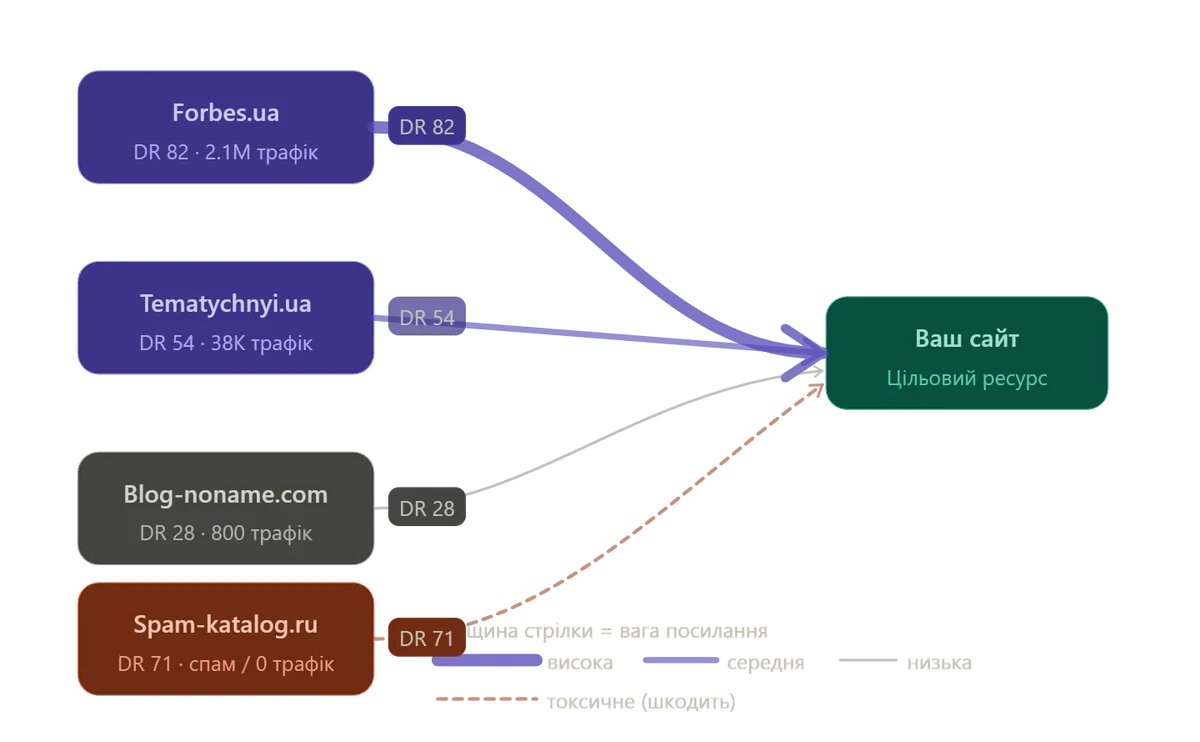
Backlinks are, figuratively, votes from other sites in your favour. The more high-quality, topically relevant domains link to you, the stronger your authority looks to Google.
But there is a nuance I learned the hard way through other people's mistakes: “more links equals better” has not been true for a long time. A hundred links from spammy directories and link farms will only hurt. Ten links from real topical blogs, media, or industry portals usually move the needle far more.
Effective tactics today: guest posts on authoritative sites, PR placements, crowd marketing (organic brand mentions in forums and comments), partner content. It also pays to study competitors' link profiles — wherever they earn links, you probably should show up too.
Step-by-step SEO promotion for a site
Below is the sequence I follow on most projects. It shifts depending on site state and niche, but the logic stays the same:
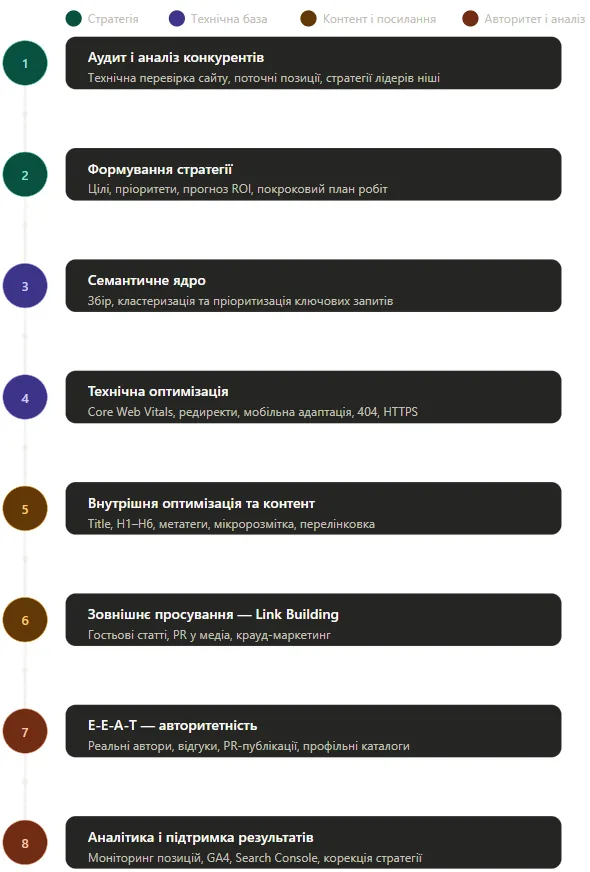
SEO or paid search: how to choose
Let us compare the two channels honestly, without sales hype:
| Factor | SEO | Paid search (PPC) |
|---|---|---|
| Time to results | Typically 3–6 months | Almost immediately after launch |
| Cost per click | Free (you pay for the work) | You pay for each click |
| When you stop spending | Effects tend to persist | Traffic usually drops right away |
| Audience trust | Higher — organic feels earned | Lower — the “Ad” label is visible |
| Query coverage | Broad — hundreds of terms | Limited by budget |
| Stability | Depends on algorithm updates | Stable while budget lasts |
In my experience the best approach is to combine both: PPC delivers quick wins while SEO ramps up. After 6–12 months organic traffic often carries more of the load and you can trim ad spend.
Combined: SEO + ads
If you need a fast start and long-term organic growth, we can align budget and priorities together.
Contact usWhat an SEO specialist does — and what to expect
“Who is an SEO?” is one of the first questions clients ask. In short: an SEO specialist designs and executes how your site shows up in search engines. In detail: someone who thinks like an analyst (reads the numbers and finds growth levers), like an engineer (knows why the site is slow and how to fix it in code), and like a marketer (understands what the person typing the query actually wants).
Day to day: technical audits, keyword research and clustering, briefs for developers and copywriters, competitor backlink analysis, tracking rankings and traffic in Search Console and GA4 — and constantly adjusting the plan when algorithms change.
One rule I learned early: if an agency promises “#1 on Google in two weeks”, walk away. Ranking algorithms are Google's trade secret; nobody can honestly guarantee a specific position. A professional guarantees quality of execution and transparent reporting — that is enough for results to appear.
Foundational reading for the logic without buzzword soup: Yoast's “What is SEO” — a solid primer for newcomers.
SEO upsides and hard truths — no sugar coating
I talk about both benefits and friction on purpose: clients who see both sides make calmer decisions.
What SEO gives you when done well: durable targeted traffic that does not vanish when ads switch off; lower long-term acquisition cost; higher trust for organic listings than for ads; a better site overall — technical work and content upgrades help real users, not only bots.
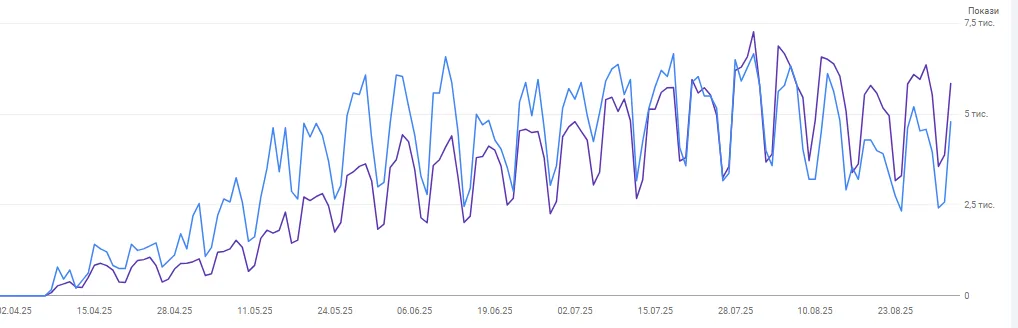
What to budget for: visible movement often takes 3–6 months — that is normal, not failure; Google updates roll out regularly and strategy must adapt; SEO is not “once and done” — it is ongoing; roughly half the outcome depends on how fast your developers ship technical fixes.
Conclusion
SEO is not magic and not an overnight customer tap. It is an investment in long-term visibility online. Done right, it keeps working even after the heaviest project phase ends — and that is its main edge over any purely paid channel.
In my experience the biggest wins do not come from “secret tricks” but from consistency: a technically sound site, useful content from real experts, natural authority growth, and steady measurement. Add E-E-A-T and structured data — and you are already ahead of competitors who still think SEO means “keywords in the text”.

Вам может быть интересно
Нужен аудит или продвижение?
Сведём техническое состояние, контент и внешний авторитет так, чтобы и поисковики, и люди вас находили — с прозрачной отчётностью.